- Home
- Departments
- Environmental Services
- School Resources
- Waste Sorting Implementation
Waste Sorting Implementation
 California SB 1383 requires all local education agencies - including K-12 public and charter schools, school districts, and county offices of education - to implement programs that reduce waste and divert recyclables and organic waste from landfills.
Contact Us
-
Conservation Coordinator
Email the Conservation CoordinatorPhone: 530-661-2063
Overview
When food scraps and other organic materials go to the landfill, the rotting process releases a greenhouse gas called methane, a potent climate change pollutant. State scientists agree that California's recent climate shift is resulting in more frequent and prolonged droughts, more intense winter storms and damaging wildfires, and rising sea levels, among other impacts1, 2. To help mitigate these effects, California has implemented a statewide organic waste recycling and surplus food recovery law called Senate Bill (SB) 1383, also known as the Short-Lived Climate Pollutant Reduction Law.
SB 1383 has two main goals:
- Reduce the disposal of compostable waste to landfills by 75% by 2025.
- Recover at least 20% of edible food currently disposed of in landfills by 2025.
Since landfills are the third largest source of human-created methane in the United States, keeping organic waste out of the landfill and edible food diverted to people in need is a simple but important step we can take against climate change.
Staff Resources
SB 1383 Requirements for Schools and Educational Agencies
Most requirements fall under the jurisdiction of the district office or governing body, but individual sites may be responsible for ensuring each requirement is being met long-term. As commercial businesses, SB 1383 also applies to privately funded schools and daycares.
- Subscribe to recycling and organic waste collection services through a franchised waste hauler. This is typically managed through a district office. The City of Woodland's contracted franchise waste hauler is WM®.
- Provide an adequate number and size of clearly marked and readily accessible recycling and/or organics collection containers for staff, students, and visitors to use.
- Container bodies, lids, and/or signage should follow this color scheme: black or gray for garbage, blue for recycling, and green for organics. Labels or signage must be included to specify what materials are accepted in each container.
- Recycling bins should always be placed next to trash receptacles, except in restrooms, and organics collection bins must be added as a third receptacle wherever organic waste is generated.
- Periodically inspect containers for contamination. Remove and resort contamination.
- Educate staff and students on proper organics and waste sorting.
- Effective January 1, 2024, work with a local food recovery organization to recover (donate) edible food, if applicable.
Under SB 1383, organic waste includes food scraps, food-soiled paper products, landscape and pruning waste, organic textiles, and untreated wood. Accepted recyclables includes most paper products and cardboard, metals, plastics #1-7, and glass.
Woodland Municipal Code § 13.72 also requires all Woodland businesses, public entities, and residents to follow the requirements of SB 1383, as well as all other applicable state recycling and organics laws.
Pre-Recorded Informational Webinars
An introduction to why all Woodland schools must sort their waste.
An overview of school and district requirements for SB 1383 compliance.
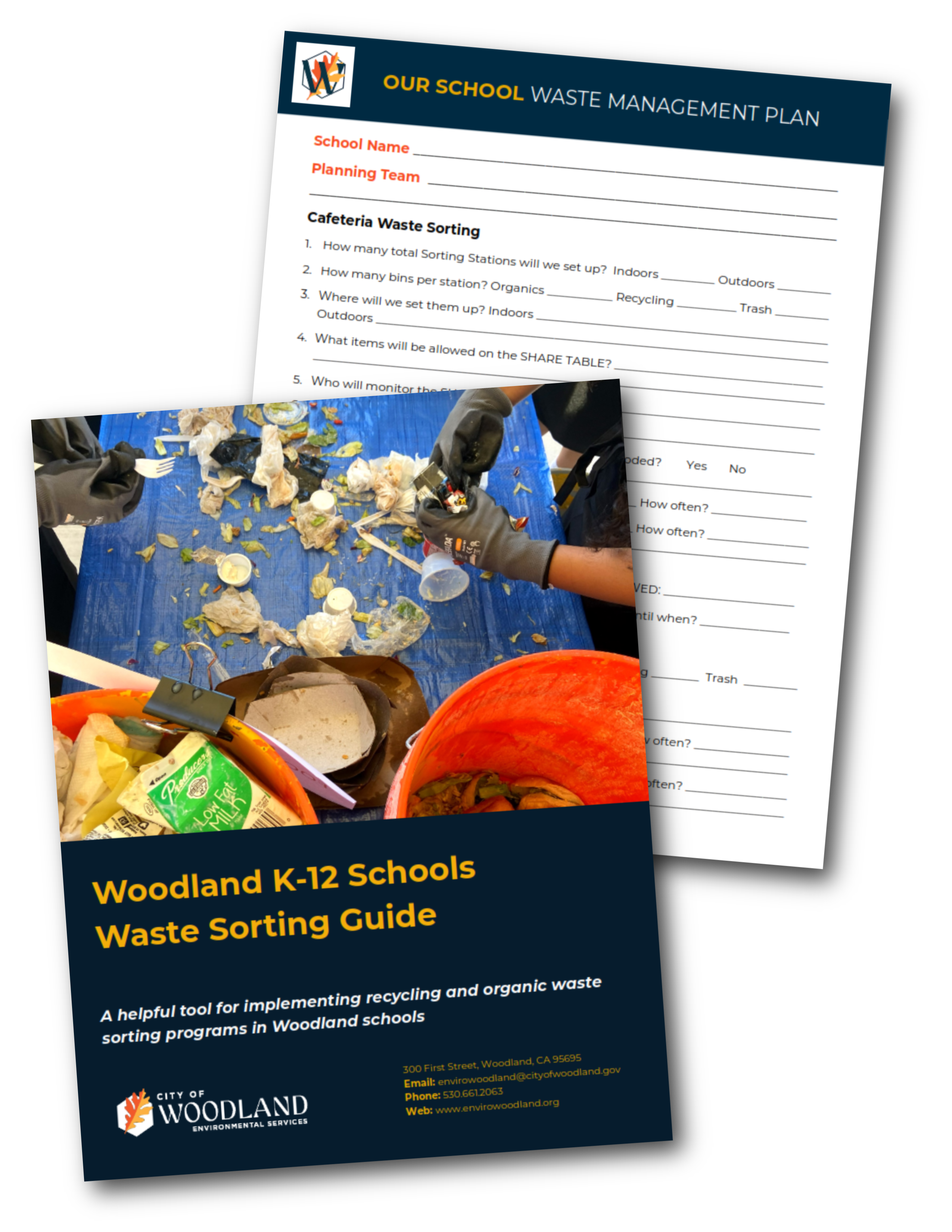 Implementation Guide
Download the free implementation guide and planning tool designed to provide public and private K-12 Woodland schools with essential information and practical tips on how to implement California’s state-mandated recycling and organic waste diversion programs on every campus.
Use the annual refresher flyer at the start of every school year to make sure your program is ready.
Printable Signage
Providing adequate signage is the key to having properly sorted, uncontaminated organics and recycling bins. Print, laminate, and display the signage (English/Spanish) linked below and add to your waste sorting stations to help staff, students, and visitors properly sort their waste.
- All Signage ( Full Color | Printer Friendly )
- Liquid Waste ( Full Color | Printer Friendly )
- Organic Waste ( Full Color | Printer Friendly )
- Recycling ( Full Color | Printer Friendly )
- Trash ( Full Color | Printer Friendly )
The Carton Council also offers the following optional signage to support liquid waste disposal, as well as additional resources:
- Elementary Schools ( Full Color )
- High Schools ( Full Color )
Support Staff Guides
Support staff and custodians play a critical role in the success of every school's waste sorting program. Site administrators should meet with their staff to review these informational flyers (English/Spanish) as well as discuss the program logistics, expectations, and administration of student rewards or incentives.
Pre-Recorded Informational Webinar
An overview of how to set up waste sorting stations in school cafeterias.
Training Videos
Use these videos featuring real Woodland students as a quick waste sorting training tool or instant refresher.
Grades TK-6
Defines organic waste and recycling and introduces proper waste sorting techniques in Yolo County.
Grades 6-8
Focuses on food waste prevention and expands on locally relevant waste sorting waste sorting procedures.
Grades 9-12
Students examine their school's waste and while properly sorting it, make connections to the climate disruption.
Training Slide Decks
The following slide decks can be facilitated by a teacher or principal as part of an assembly, or by individual teachers in their respective classroom as part of a lesson or even on the first day of school. Every slide deck includes presenter notes that can be read like a script and include discussion prompts and extension activities to make the learning experience as valuable and interdisciplinary as possible.
Grades TK-6
30 minute version
15 minute version
Virtual sorting practice/quiz
Grades 7-12
30 minute version
15 minute version
Rewards/Incentives
Encouraging students to consistently sort waste can be challenging, but rewards can motivate them and highlight the importance of their actions. We invite you to download or make a copy of the "Tidy Titan Awards" slide deck below and use the chart as a way to help students visualize their waste sorting performance, address other skills like keeping floors and tables tidy, and gamify the task for a well-deserved prize.
More ideas are included in the Woodland K-12 Schools Waste Sorting Guide.
Instructions for using the chart are contained in the presenter notes.
Food Recovery in Schools
Food recovery is an important tool for preventing food waste and feeding the 1 in 5 Californians currently experiencing food insecurity. To address both problems, schools with commercial kitchens are required by SB 1383 to recover edible food that would otherwise be thrown away and donate them to a local food recovery organization, such as the Yolo Food Bank. This requires a formal agreement with the food recovery organization and donation record-keeping.
For helpful information on setting up a food recovery program, explore the K-12 schools food recovery roadmap created by Nancy Deming and Janet Whited of Oakland and San Diego Unified School Districts in 2018.
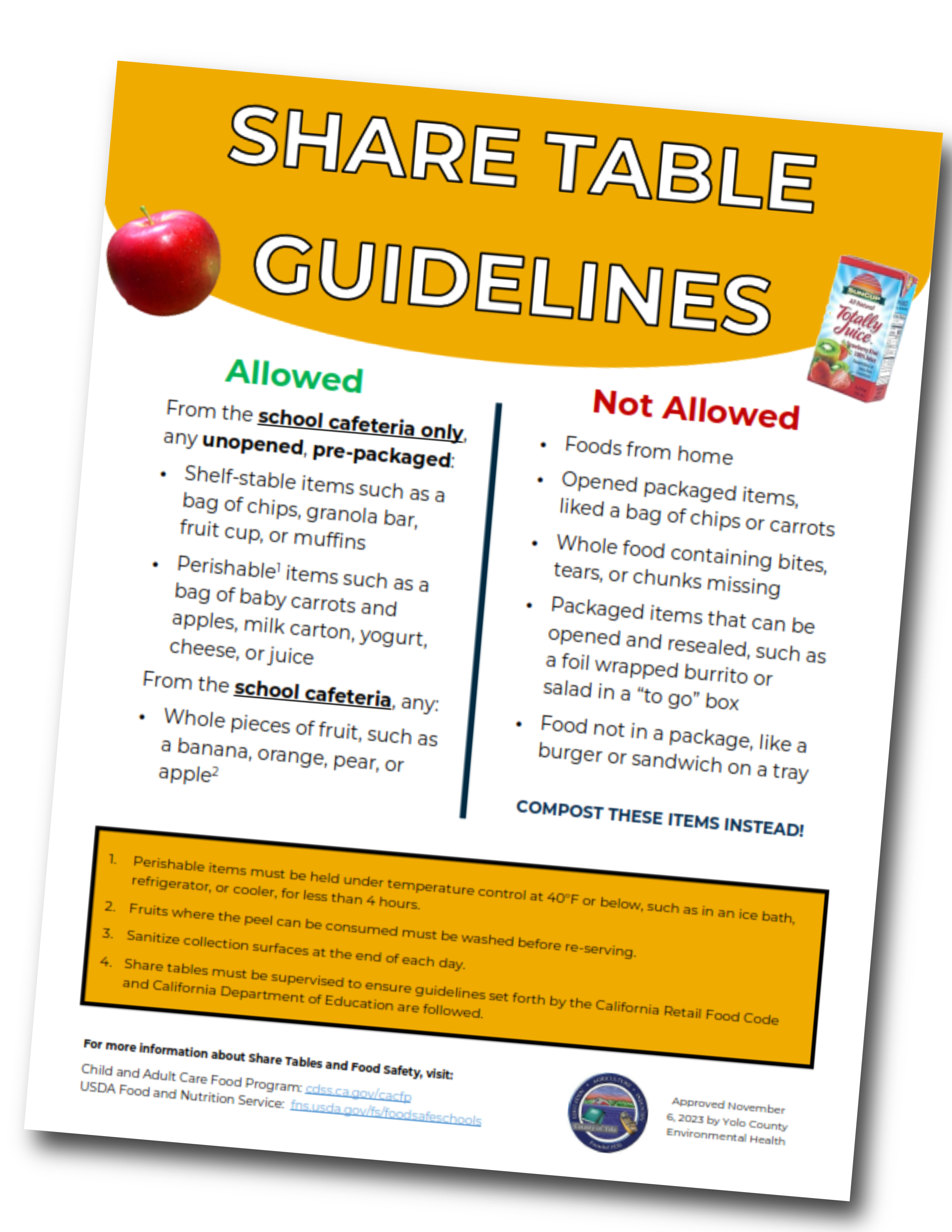 Share Tables
A "Share Table" program allows students to share unopened or uneaten food items from the cafeteria, thereby reducing waste and providing extra food for those children who need it.
Schools can scale their food share programs up or down as long as mandatory county and state Food Safety Guidelines are being followed in a way that prevents food-born illnesses. What can be collected for the Share Table, how, and where should be decided with and approved by nutrition or food safety supervisors.
Download the Share Table Guidelines to help you safely manage a food share program at your school in accordance with Yolo County Environmental Health food safety guidelines.
Enabling Legislation
In addition to SB 1383, several state and federal laws enabler food share programs and food recovery in school environments, including:
SB 557 - School Food Donation Act
Allows California public schools to set up share tables where students can return unopened or uneaten food items during mealtimes. Schools may safely redistribute these items to other students or donate them to food banks and nonprofit organizations to reduce waste and address food insecurity. The bill ensures that donations follow food safety guidelines, including maintaining proper storage temperatures and using only non-potentially hazardous or properly packaged items. It reinforces and lists what foods schools can donate and add to “share tables,” and specifically called for California Health and Safety (Health and Safety Code 114079) and California Department of Education (CDE) to update its guidelines to match.
AB 1219 - Good Samaritan Food Donation Act
Schools, food service staff, and districts are protected from liability when donating in good faith to nonprofits or food recovery organizations. They are also protected when directly distributing safe, excess food to students or families (e.g., at the end of the school day or during food pantry events).
National School Lunch Act
Allows students to save/eat items outside of a meal service area as long as the food items do not require cooling or heating.
Frequently Asked Questions
How many waste sorting stations should we set up, and where?
We recommend at least two waste sorting stations per designated eating area. Double up on bins or keep extra bins handy in case of overflow. Stations should be set up in a way that would allow for one-way flow, preferably on an "exit route".
Who is responsible for monitoring the bins and ensuring proper sorting?
Ideally students are adequately trained and prepared at the start of the school year to ensure that they always sort their own items correctly. Oversight will vary by site. In some schools, it is the custodian's responsibility. In others, the responsibility is shared between custodians and noon duties. In some cases, student volunteers run the program with the support of the custodian or another staff member or volunteer.
What support or funding is available for setting up a waste sorting program?
From 2023-2025, City of Woodland Environmental Services partnered with Woodland Joint Unified School District (WJUSD) and used grant funds to purchase all of the bins and signage that would be necessary for any WJUSD school to implement or advance their cafeteria waste sorting program. Those funds have been exhausted. However, we continue to offer free education and training resources. Otherwise, we encourage schools to connect with their district office or local PTA/PTO for assistance.
How can we reduce food waste generated in our cafeterias?
Use the strategies outlined by the Smarter Lunchroom Movement, which includes low to no-cost ideas that get students to eat more and waste less. The most successful strategies include offering recess before lunch, longer sit-down time, and promoting fruits and vegetables creatively through unique menu names.
How can we measure the success or impact of our waste sorting efforts?
One approach is to conduct waste audits. There are numerous sources available online and in our free K-12 curriculum guide.
Can we recycle shredded paper?
No. Shredded paper must be collected in a bag and discarded in the trash. However, if the shredded paper is completely free of metals (staples, paper clips) or plastic (tape, receipt paper, etc.), it can be added to the organics bin and then wetted down so that it doesn't blow away and become litter.
1 California Department of Water Resources, Climate Change Program. https://water.ca.gov/Programs/All-Programs/Climate-Change-Program.
2 State of California, California Climate Adaptation Strategy. https://climateresilience.ca.gov/overview/impacts.html